What Is Tarot?
A Brief History
Tarot is a standard 78-card deck. Many readers use it as a tool for reflection and self-awareness rather than as a factual prediction system. The earliest documented use comes from Italy in the fifteenth century, where the cards were a popular game1. The Visconti-Sforza deck, created around 1450, is one of the earliest and most complete surviving decks. In the eighteenth and nineteenth centuries, occult scholars connected the imagery to Egyptian mystery traditions, Hermetic philosophy, Kabbalah, and alchemy. This Egyptian link is part of occult tradition; the source notes these scholars may have “revealed (or created!)” that history1.
The Rider-Waite deck, drawn by Pamela Colman Smith in 1909, is widely recommended for beginners because its imagery is intuitive.
How Tarot Is Used Today
A traditional reading usually involves a seeker with a question and a reader who lays cards in a pattern called a spread. Think of a spread as the arrangement of cards you use for a reading; each position gives a card a particular job. The reader combines the meaning of each card with the meaning of its position to address the question. Many contemporary readers treat tarot as a mirror for reflection rather than as a source of fixed predictions. A card in a future position is often described as a possible or likely direction if nothing changes, not a fixed event.
Tarot does not require psychic ability. The guidance is a reflection of your own inner knowing. Readers also work with the imagery and their intuitive impressions. That is enough to begin.
Getting to Know the 78-Card Deck
Major Arcana
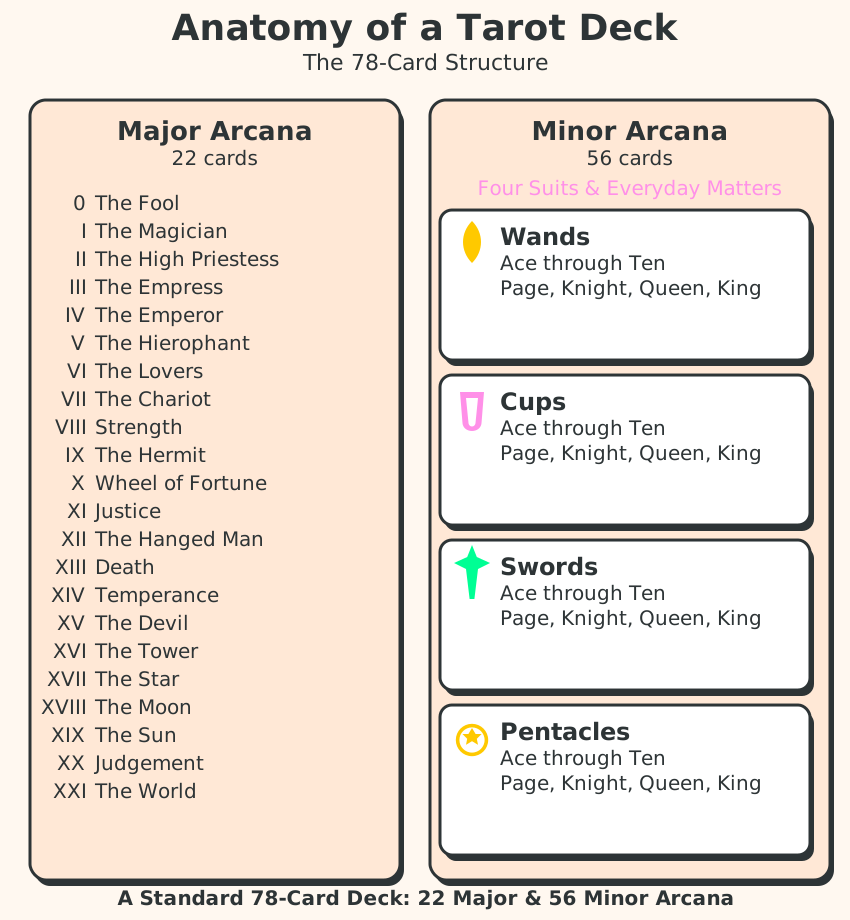
A standard deck has 78 cards: 22 Major Arcana numbered The Fool (0) through The World (21), plus 56 Minor Arcana. Major Arcana cards often represent major life themes. In many readings, a spread heavy in Major Arcana points to a matter that may be largely outside the seeker’s hands and highly spiritual.
Minor Arcana and Suits
The Minor Arcana are divided into four suits: Wands, Swords, Pentacles, and Cups. In common tarot teaching, each suit carries a broad energy:
| Suit | Traditional association |
|---|---|
| Wands | action, creativity, will |
| Cups | emotions, intuition |
| Swords | intellect, communication |
| Pentacles | finances, work, environment |
These associations come from traditional suit meanings used by many readers and authors. They are a shorthand, not a rigid law.
Numbers and Court Cards
Within the Minor Arcana, Aces and court cards carry traditional roles: Aces often signal potential or energy that has not yet fully taken form, and court cards often point to people involved in the issue. You do not need to memorize all 78 cards before your first reading. A card meanings reference can help when a card is unfamiliar.
Preparing for Your First Reading
Create a Quiet Space
Find a calm place where you are unlikely to be interrupted. A comfortable, uninterrupted space with your cards and your written question at hand is enough.
Set Your Intention
Take a few slow breaths and settle into the present moment. Many readers set an intention before drawing: they are seeking insight, not a fixed prediction. Write the question down so it stays clear while you shuffle. Some readers also say the question aloud exactly as written.
Optional: Significator and Clarifiers
Some spreads use a significator card to represent the person asking. This is optional and not needed for a simple three-card spread. Keep a clarifier card in mind: if a drawn card seems unclear, some readers pull one extra card and place it beside the original. Many teachers warn that extra clarifiers can add confusion, so use them sparingly.
Keep a journal or notepad nearby to record the question, cards, positions, and first impressions.
How to Formulate a Beginner-Friendly Question
What vs. Why
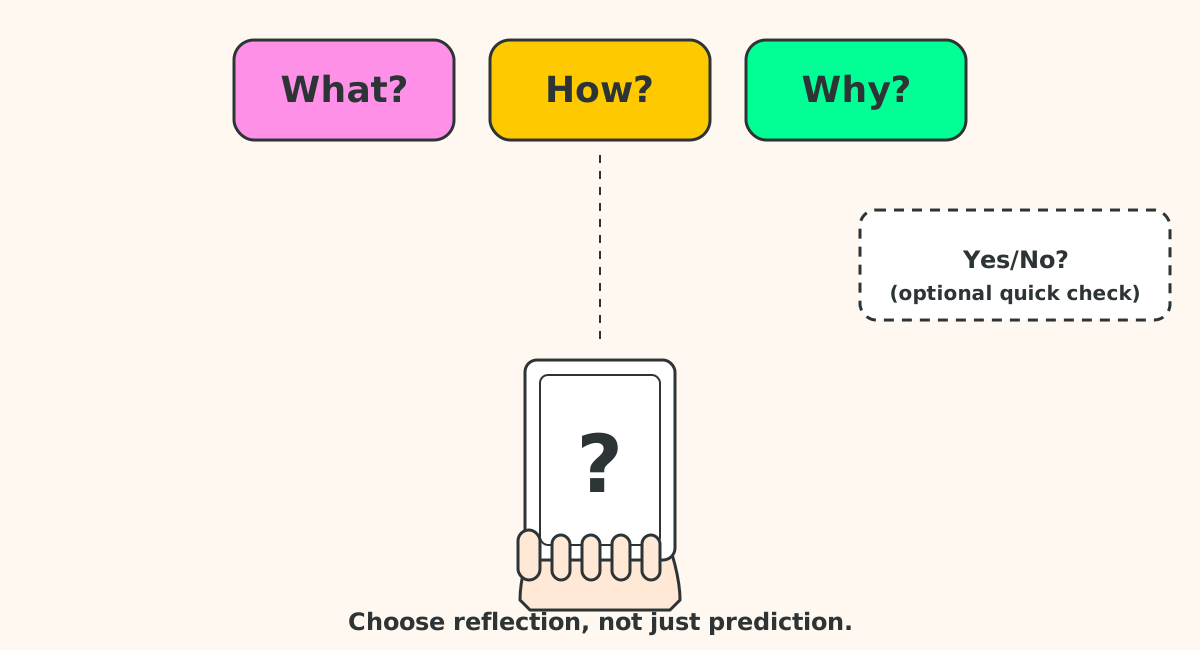
Ask brief, specific questions. Tarot teachers commonly advise that “What” questions tend to produce deeper responses than “Why” questions.
Create a Workable Question
A useful question is brief, asks what you really need to know right now, and focuses on what you can observe or influence. Useful examples:
- For a relationship question, ask “What do I need to know about my relationship right now?” rather than a fixed predictive question.
- For a career question, ask “What can I do to increase my chances of getting the promotion?” rather than a fixed predictive question.
Questions to Avoid
Leave health, financial, and legal questions to professionals. Avoid yes/no predictive questions that assume a fixed future, such as “When will X happen?”. A better structure is often “What do I really need to know right now?”.
Shuffling and Drawing Cards
Basic Shuffle
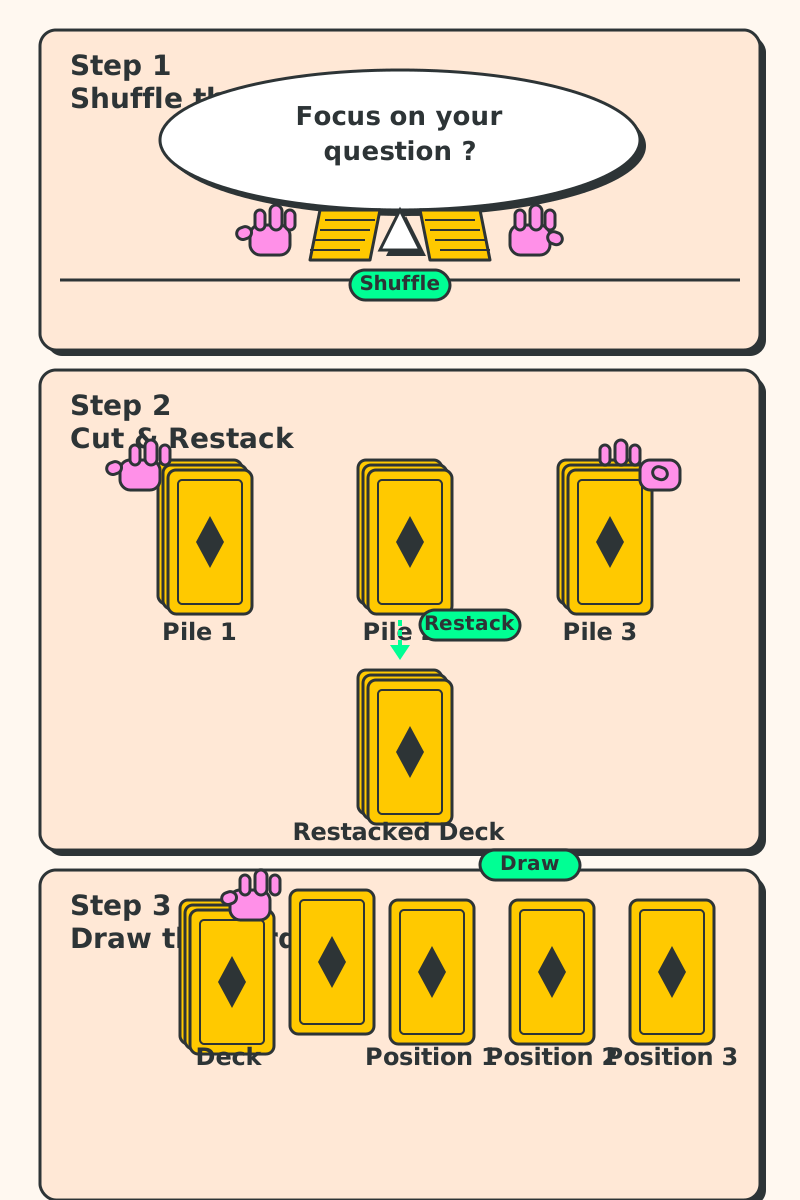
No single shuffle ritual is mandatory; the details are less important than mindfulness. Any thorough method that mixes the cards works. If riffle shuffling feels clumsy, spread the cards face down on a table, swirl them gently, and gather them back into a stack. While shuffling, hold the question or its overall intent in mind.
Cutting and Drawing
Cutting is optional. Some readers split the deck into two piles, and others use three piles before restacking. After shuffling, draw cards one at a time and place them in their numbered spread positions, turning each card over like a page of a book.
Using Clarifiers
If a card seems unclear, some readers draw one additional clarifier card and set it beside the original; read the two together rather than pulling many extra cards. That keeps the spread readable.
Choosing a Simple Spread
Three-Card Spread Options
Small spreads are easier to interpret than large ones. A three-card spread is a solid first choice.
| Spread | Positions |
|---|---|
| Past / Present / Future | recent influences, current situation, likely direction |
| Opportunity / Challenge / Outcome | what supports, what resists, probable result |
| Issue / Challenge / Action | core question, obstacle, suggested step |
| Situation / Challenge / Advice | present state, friction, practical counsel |
These layouts are common in beginner teaching.
Why Small Spreads Work
Past/Present/Future is a classic and often easy first layout because each position has a clear time reference. If your question is action-oriented, Situation/Challenge/Advice may speak more directly. Choose the spread whose positions match the question rather than forcing every question into a fixed shape. You can use the Three-Card Tarot (Past, Present, Future) if you prefer guided prompts.
Combining Card Positions and Meanings
Position as Noun, Card as Verb
A useful method is to combine the card meaning with the position meaning, as if the position were the context and the card were the energy moving within it. For example, Past position plus The Hermit might read as “a period of solitary searching that shaped the present.” This keeps you from reading a card in isolation and pushes you toward a sentence rather than a list of keywords.
Reading Suit Energies
Before interpreting each card, notice the overall suit balance. In common teaching, Wands bring action, Cups bring emotion, Swords bring intellect or communication, and Pentacles bring finances, work, or environment. A spread heavy in Major Arcana often signals a largely fated, highly spiritual matter.
Notice Symbols and Direction
Pay attention to symbols, colors, repeating suits or numbers, and the visual flow of the spread before moving card by card.
A worked example can make this concrete. Suppose the question is: “What do I need to know about my current creative project and how to move forward?” Spread: Past/Present/Future with upright Rider-Waite-Smith cards.
- Card 1, Past: Four of Swords — one possible reading is a period of rest, recovery, or stepping back after burnout.
- Card 2, Present: The Magician — one possible reading is having the tools, skill, and willpower to create; a call to focus and act.
- Card 3, Future: Three of Cups — one possible reading is collaboration, celebration, and shared success.
Reading: You recently took a needed pause (Four of Swords). Now you have everything you need to begin creating (The Magician). If you act with focus and invite collaborators, the project is likely to lead to joyful shared success (Three of Cups). Action step: stop second-guessing your preparation and share your work in a small group this week.
This example combines card meanings with position meanings and treats the future position as a probable direction, not a fixed result.
Interpreting the Whole Reading
Build a Sentence
When you have considered each card, look for relationships between them and tell the story aloud or in a short paragraph.
Check the Narrative Arc
Look for movement across the positions. The past position can show earlier energy or baggage still influencing the present; the present position shows the current focus; the future position suggests a possible direction if nothing shifts.
Many readers use the final card’s type as a cue. A Major Arcana ending often suggests the outcome is largely out of the querent’s hands; a court-card ending often points to another person’s role; a numbered-card ending often suggests the querent can act.
Do a Second Pass
If a card seems contradictory or nonsensical, practice patience and curiosity rather than pulling many clarifiers. Return to the original question and answer it from the cards. Review earlier readings over time to note what happened and what you learned.
Common Beginner Mistakes to Avoid
Vague or Forced Questions
Keep questions brief and to the point, because the quality of the answer depends on the quality of the question. Avoid forcing a question into yes/no terms when you actually want guidance.
Overcomplicating Spreads
Do not start with a ten-card Celtic Cross. Nearly every beginner book includes it, but it is not a good place to start. Begin with one-, two-, or three-card spreads until the process feels familiar.
Projecting and Polarity
If you approach a reading from panic or are open to only one answer, the reading may show that state back to you. If a card seems unclear, stay patient and curious rather than discarding it. Pay attention to the story the images tell, which may differ from textbook meanings.
How to Practice and Build Your Skills
Daily Draw
Pull one card a day and ask something like “What do I need to know today?” or “What energy do I need to focus on today?”. Note the card and your first impressions, then compare them with a traditional interpretation. At the end of the day, compare the card with what actually happened.
Journaling Prompts
Use summary prompts when you finish a reading: What is the problem or conflict? What is your role? What guidance do you take from the reading? What is the projected outcome? What action can you take?. These are not predictive questions; they help you practice reading yourself.
Learning Card Meanings
Study card meanings gradually. Pick one card a day and read its entry in the All 78 Tarot Card Meanings guide. Compare your initial impression with the traditional description. When ready, try the Free Tarot Reading tool or the Three-Card Tarot spread to build confidence. Revisit your journal regularly to notice patterns in your interpretations.