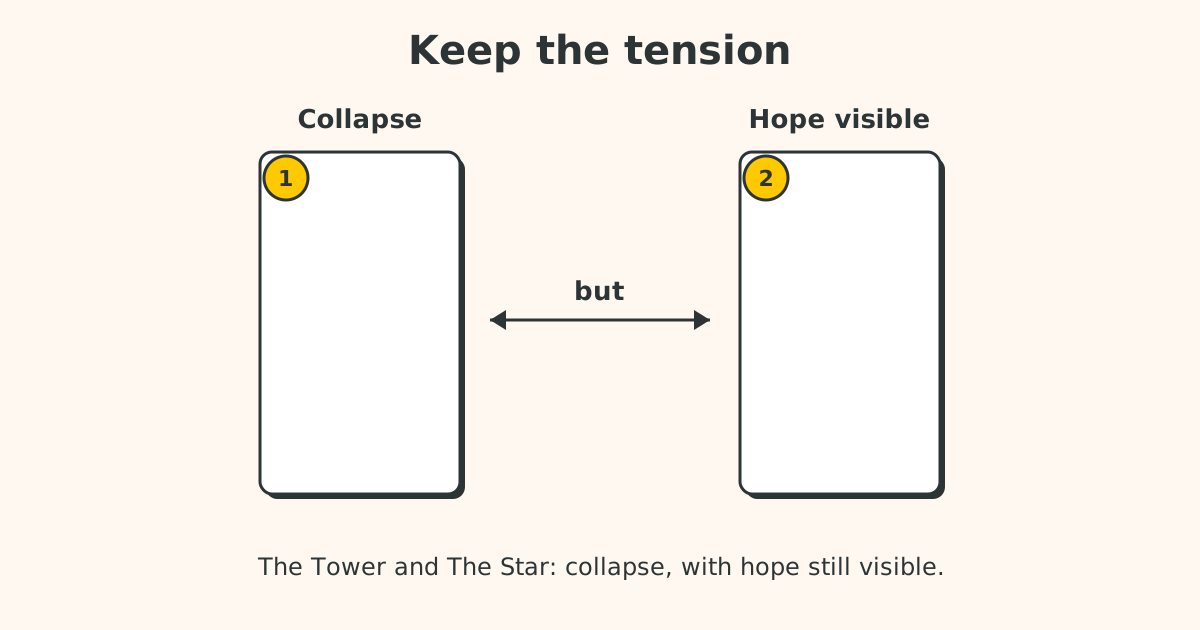
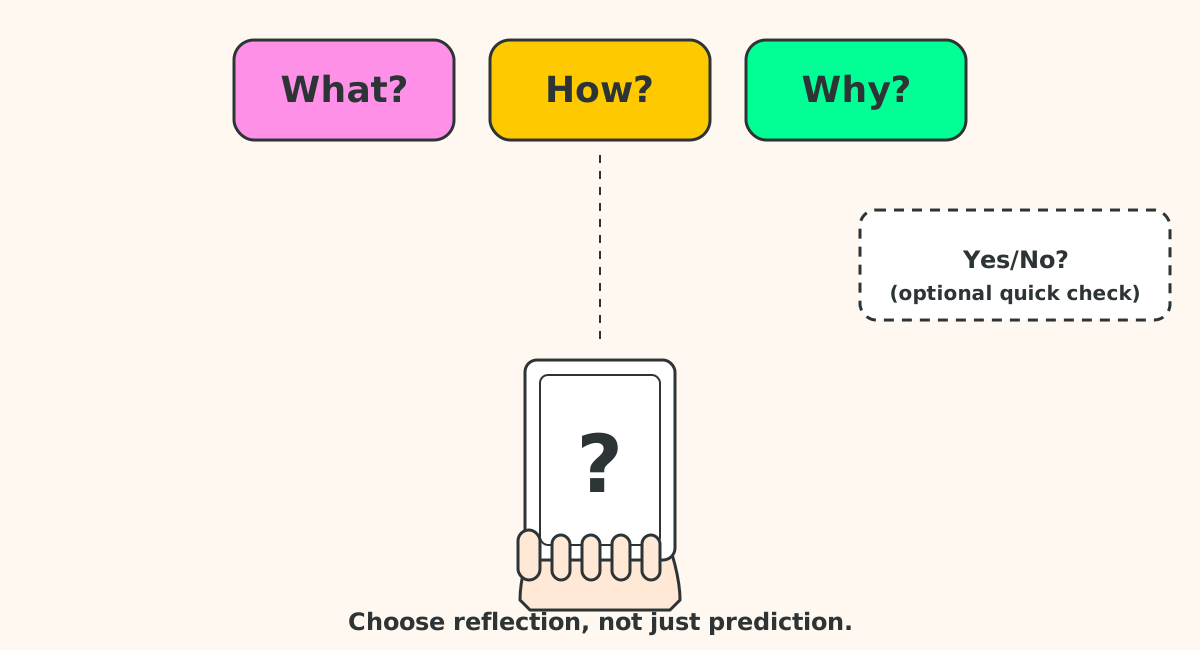
What Is a Tarot Spread?
A tarot spread is a set of positions that gives each card an interpretive job. When you lay out cards in a spread, you are not just pairing images; you are assigning each card a specific question to answer. One card might represent the past, another the obstacle, another the advice.
Positions can represent time frames, people, internal factors, obstacles, advice, or outcomes. The position is part of the card's meaning. The same card in a "past" position means something different than it does in an "advice" position.
The job of each card
Think of each position as a job description. If you draw the Five of Pentacles in a position labeled "what you bring," you read it as what you are bringing. If the same card appears in a position called "near future," you read it as a direction or trend. The card's general meaning bends toward the job the position gives it.
That is why spread design matters. A vague spread with fuzzy positions produces a vague reading. A clear spread lets a single card do one job cleanly.
Question first, spread second
Write the question before you choose a layout. No spread can rescue a vague, invasive, or unanswerable prompt. A question like "What does the universe want me to know?" is so broad that almost any card can be made to fit. A question like "What deserves attention in today's meeting?" gives a card something specific to do.
The best spread is the smallest structure that can answer the question clearly. Start from the question, list what you actually need to know, and choose the layout that gives each of those needs a card. Adding more cards does not make the answer more accurate; it just increases the material you have to integrate.
One-Card Readings: When Less Is Enough
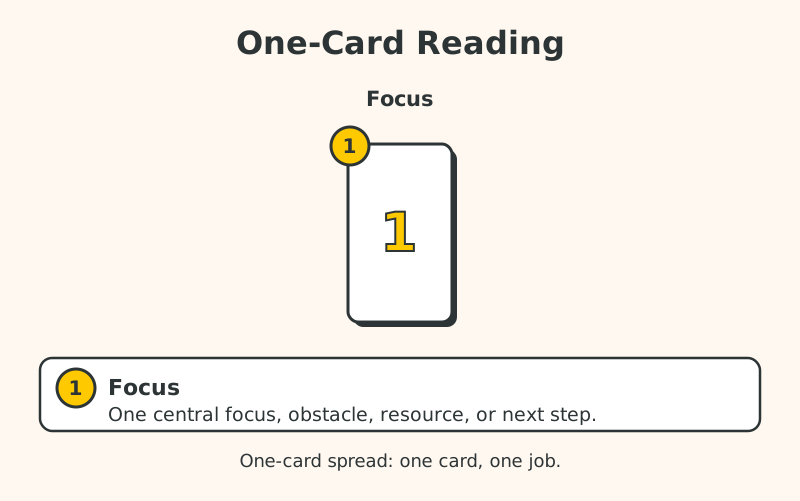
A one-card spread is exactly what it sounds like: one card, one position, one job. It works when you need a single focused answer rather than a multi-part story.
What a single card can do
One card suits a daily focus, a central issue, one obstacle or resource, a journaling prompt, or the next constructive action. The single position can be assigned one of those jobs depending on intent.
A daily focus is a common one-card format. You can use the Card of the Day pull for a simple daily check-in. If you pull a card each morning without a specific question, you are doing something close to a journaling prompt. If you add a specific question, the same card becomes a focused reading.
How to ask a one-card question
Pair the single position with a specific question. The meeting example from earlier is a good one here because it gives the card a narrow target; the broad universe question lets almost any card fit.
Say you ask about the meeting and draw The Fool. The position gives the card a narrow target: the reading should address what deserves attention in that meeting, not deliver a general life prediction. The card's general meanings are then read through that target.
A one-card pull is not the right tool for a layered question with multiple factors. If your question has a "but also" or an "and then," you probably need more positions.
Yes or No Readings: Beyond Positive vs. Negative Cards
Yes/No readings are possible, but they are trickier than they look. Sometimes a simple yes or no is genuinely what someone wants, yet a bare answer gives the querent very little to work with.
Why simple Yes/No is tricky
A common online method assigns positive cards to "yes" and negative cards to "no". That convention is familiar, but it is criticized as ill-defined: what counts as a wholly positive or wholly negative card? Reducing every card to a yes/no value flattens that nuance.
Practitioners who discuss future positions in three-card readings treat them as directions rather than fixed fate. A yes/no spread framed as a fixed prediction is less useful than one that gives you the conditions attached to each option.
The Yes, if / No, if method
A more practical method is called "Yes, if / No, if." You draw one card for "yes, you should do it IF..." and one for "no, you shouldn't do it IF...". Often this pair sits inside a three-card reading that opens with a current-situation card or closes with general advice. You can practice the structure with the Yes or No Tarot tool, but the method matters more than the tool.
Here is the worked example from TABI's spread of the month. The question is "I have the chance to move abroad for work. Should I do it?" You draw Knight of Swords in the Yes-if position, Queen of Pentacles in the No-if position, and The World as advice.
Read the Yes-if card as: take the job if you can move quickly and you are up for adventure. Read the No-if card as: do not take it if being settled at home matters more than adventure. The Queen of Pentacles also suggests there may be more money in staying home, so that becomes a real factor in the decision. The World as advice suggests either decision can ultimately be a good one.
Notice what is happening: the yes and no are not fixed verdicts. Each one carries a condition, and the advice card reminds you that the decision is yours to make. That is a far more usable reading than a flat yes or no.
Three-Card Spreads: The Workhorse Layout
The three-card spread is the one most people learn after the single card. It gives you enough structure for a beginning, middle, and end without asking you to hold ten positions in your head.
Past, Present, Future and its limits
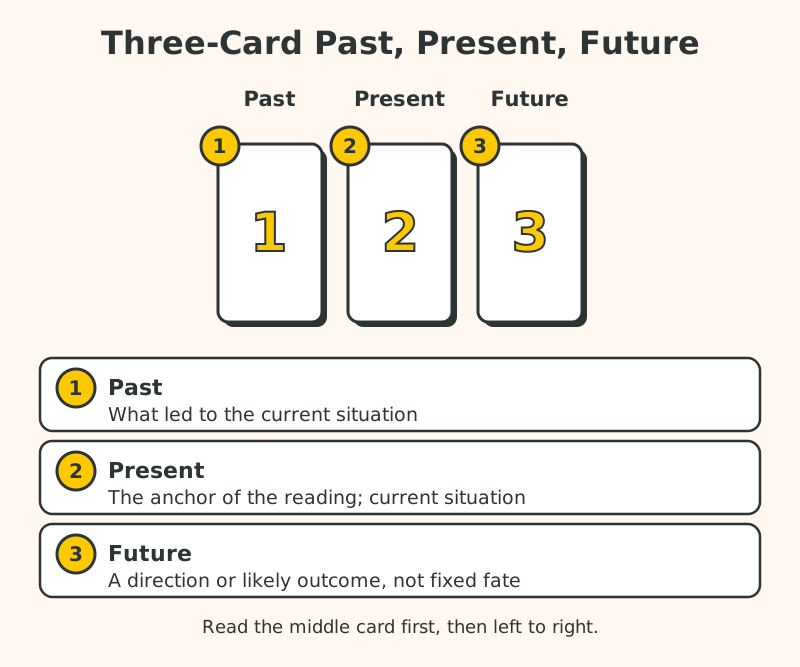
The Past, Present, Future layout is common and useful, but it is one variant, not the definition of a three-card spread. In this layout, the past position shows what led to the current situation, the present is the anchor of the reading, and the future shows a direction rather than a fixed fate. The future card is read as a likely direction under current conditions, not an inevitability.
Read the middle card first, then left to right as one sentence. If the past is Five of Pentacles, the present is Six of Cups reversed, and the future is Ace of Pentacles, you might say: because of past hardship, I am now stuck in nostalgia, so the next step is a fresh practical start.
Other three-card variants
Past, Present, Future is not the only option. Other three-card sets include beginning/middle/end, wish/obstacle/resolution, problem/source/solution, and person #1/person #2/the nature of their relationship. Other variants include situation/action/outcome, situation/obstacle/advice, and mind/body/spirit. You can work through any of these with a specific question on the Three-Card Tarot page.
The same question can be read through different three-card variants, and the positions change the story. Take the question "Where am I with my work?" with these three cards: Five of Pentacles, Six of Cups reversed, and Ace of Pentacles.
Read as Past/Present/Future: the past is Five of Pentacles — financial or professional hardship that set the scene. The present is Six of Cups reversed — nostalgia for how work used to be is blocking the present. The future is Ace of Pentacles — a new practical opportunity is available.
Different variants would assign the same three cards to different jobs, and each would change the reading. That is the point of choosing a spread deliberately: the position labels quietly direct the whole interpretation.
Relationship Spreads: Reading the Space Between
Relationship spreads work best when they focus on the dynamic between two people, not on reading someone else's private thoughts without consent.
Ethical boundaries in relationship readings
There is real difference of opinion among practitioners here, which is worth stating plainly. The author of Little Red Tarot declines questions like "Does X love me?" because she will not read for someone who has not consented to a reading. The Mystica says tarot can describe the energy of a relationship and how someone is showing up, but it cannot read another person's mind. tarotclaritas takes a firmer line: in its five-card spread, the other-person position is limited to observable behavior and stated words, not inner feelings, because no card reaches that far.
These are not identical positions. The common thread is that relationship spreads are most honest — and most useful — when they keep the focus on what you bring, what you can see, and what the space between you is doing. You can begin that work with a Love Tarot Reading.
A five-card relationship spread
A common five-card relationship spread uses these positions:
| Position | Label |
|---|---|
| 1 | What you bring to the relationship now |
| 2 | How the other person is showing up in the relationship |
| 3 | The dynamic between you |
| 4 | The issue needing attention |
| 5 | Where things are heading if nothing changes |
This layout is documented by The Mystica. As an example, it might draw Queen of Cups in position 1, Knight of Swords in position 2, Five of Wands in position 3, Two of Swords in position 4, and Temperance in position 5. Read together: you are offering emotional care, they are showing up in fast goal-driven mode, the connection has small clashes, the issue needing attention is an avoided conversation, and with patience and compromise the direction can be balance.
Element pairings add another layer. Same suit in positions 1 and 2 means both people meet in the same area of life. Wands and Cups together suggest passion and feeling, strong but sometimes volatile. Swords and Pentacles suggest one person thinks while the other acts, complementary if they communicate. A Major Arcana card in a person position often suggests that person is going through something larger than the relationship itself.
Another five-card relationship spread uses positions of: you, them as far as anyone can honestly see, the space between you, what each of you brings, and one step. That spread deliberately limits the other-person card to what is observable, and it reads the fifth as a single actionable step small enough for you to take alone.
Five-Card Spreads for Decisions and Clarity
A decision spread
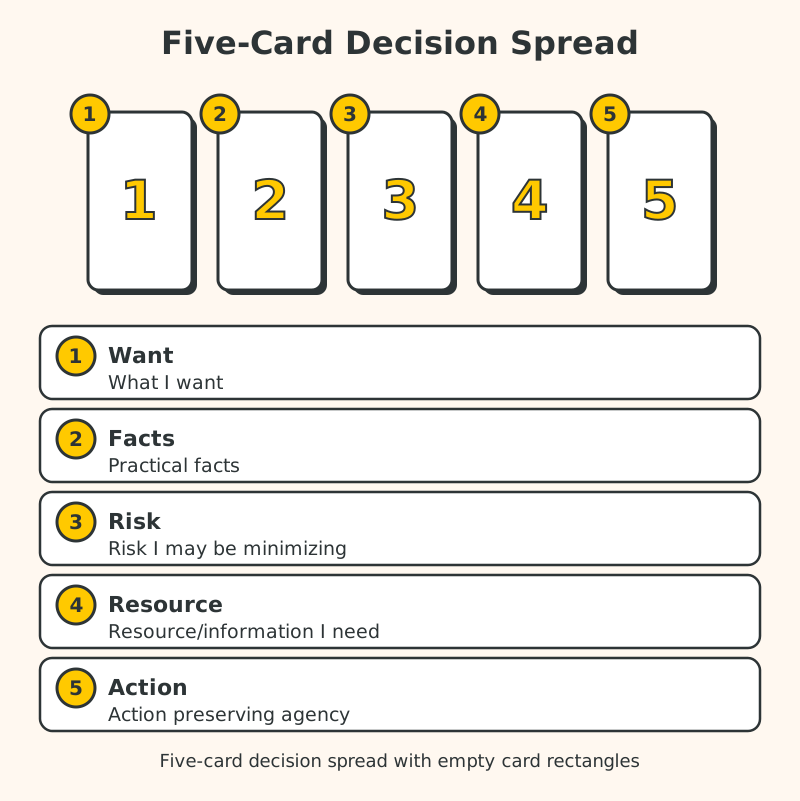
A five-card decision spread separates what you want from what the facts support, and it gives the risk and the resource their own positions. The positions are:
| Position | Label |
|---|---|
| 1 | What I want from this decision |
| 2 | What practical facts support it |
| 3 | What risk I may be minimizing |
| 4 | What resource or information I need |
| 5 | The action that preserves my agency |
This layout is useful because the extra positions distinguish internal desire from external constraints. They let want and fact sit side by side so you can see where they disagree.
When five cards beat three
Three cards work well for a beginning-middle-end or a simple past-present-future arc. Five cards can be better when a decision has several distinct parts, as in the decision spread above.
Five-card relationship layouts also exist, and the element-pairing reading described in the previous section fits naturally into that framework. The same principle holds: more positions are justified only when each position has a distinct job.
The Celtic Cross: A Ten-Card Deep Dive
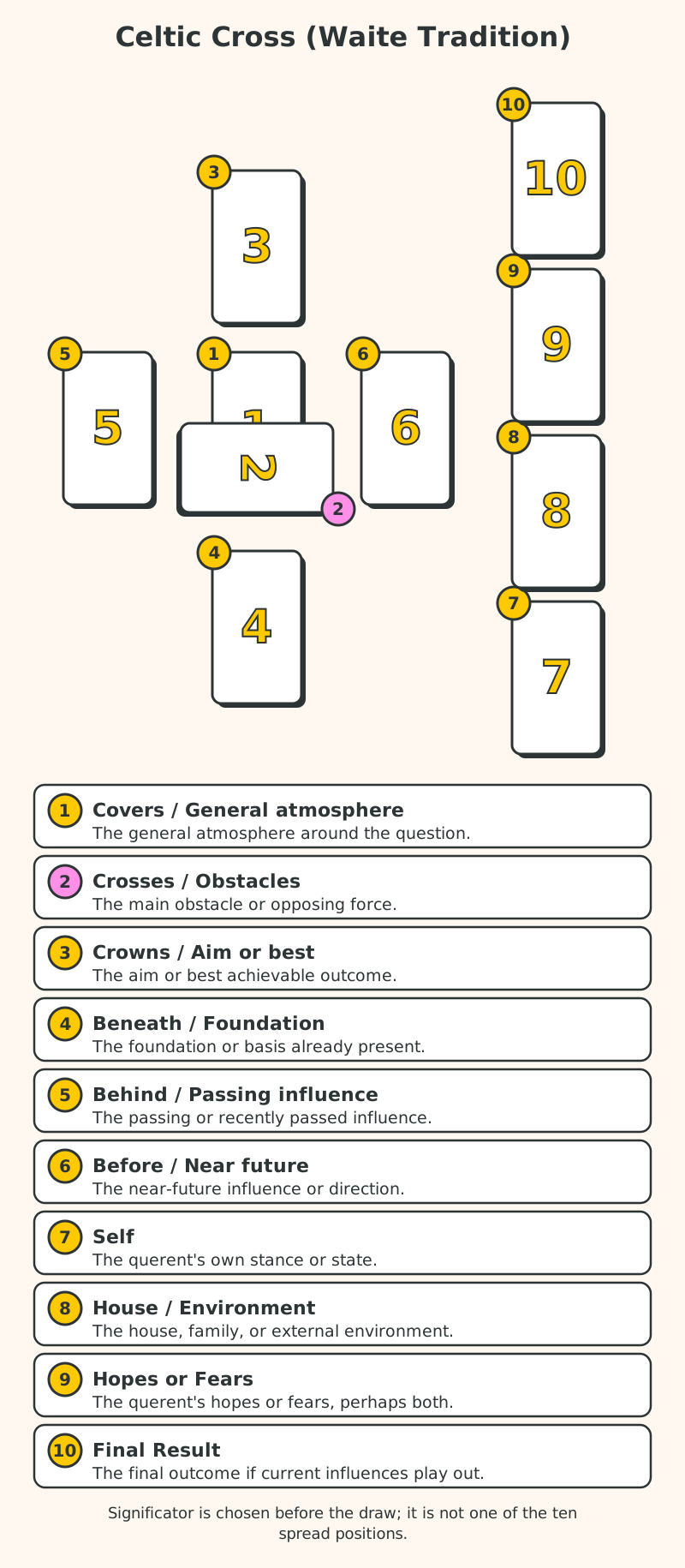
The Celtic Cross is a ten-card spread best suited to answering one definite question. Arthur Edward Waite published a version in his 1910/1911 book The Pictorial Key to the Tarot, using a Significator plus positions 1 through 101.
Waite's original positions
In Waite's published version, the Diviner first selects a Significator card to represent the person or matter about which the inquiry is made. Then:
- Covers him — the general influencing atmosphere
- Crosses him — the nature of the obstacles
- Crowns him — the aim or ideal, or the best achievable but not yet actual
- Beneath him — the foundation already made actual
- Behind him — the passing or recently passed influence
- Before him — the near-future influence
- Self
- House or environment
- Hopes or fears
- Final result
Waite instructs the reader to formulate the question definitely and repeat it aloud before beginning. If the tenth card is unclear, his suggestion is to repeat the operation using that tenth card as the new Significator. You can practice the layout with the Celtic Cross Tarot tool.
Numbering differences across traditions
Waite's labels are well documented, but they are not the only version in circulation. Numbering and position meanings vary between traditions2. A user-contributed reference at everything2 describes position 4 as long-past or childhood influence, position 5 as a just-occurred or waning force, and position 6 as a soon-to-occur or waxing force. That same entry links the ten cards to the Kabbalistic Tree of Life without citation. Another account on the same page lists different labels for some positions. So if you learn the Celtic Cross from two different teachers, you may well learn two different numbering systems.
The practical lesson is simple: use a position order you have written down, and note the source or tradition you are using. The position labels shape what each card means, so a vague or misremembered layout turns a detailed spread into ten loosely connected impressions.
When a Small Spread Is Better
Match the spread to the question
Small spreads are better when they can answer the question clearly. The Celtic Cross is frequently overused, and ten cards do not make an answer more accurate. Match the size to the job: one card for a daily focus, three for a straightforward timeline or sequence, five for a decision or relationship, and ten for a layered, multi-factor question where each position has a distinct job.
If the question is unclear, no spread will fix it. That is not a spread-size problem; it is a question-clarity problem. Write the question out, look at what it is really asking, and then choose the smallest layout that covers those parts.
Avoid overloading the reading
If a spread feels too small, the solution is often to refine the question rather than add cards. "Should I take the job?" is a yes/no question. "What do I need to understand about my work right now, and what action is mine to take?" is a broader question that may genuinely need more positions.
Reversals and position context can add depth in a small spread without adding cards. A reversed card in a three-card layout can carry a different nuance in the past, present, or future slot, which gives you more reading material from the same three pieces of cardboard.
How Positions Change a Card's Meaning
Reversed cards in time positions
Practitioner tradition reads reversed cards differently depending on position. In a past position, a reversed card often means something blocked or unfinished back then, with unfinished business still lingering. In the present, it can mean the energy is turned inward, or there is too much or too little of it. In the future, a reversed card usually suggests delay.
How card relationships change meaning
Position context shapes more than reversals. Repeated suits across positions can tell you what the reading is really about. In the work example earlier, two Pentacles with a Cups card in the middle suggested the question concerns work and money, with feelings sitting between them.
Major Arcana placement also matters. A Major Arcana card in a future position can suggest the outcome is larger than it appears. In a relationship position, a Major Arcana card can suggest that person is going through something bigger than the relationship itself.
Court cards reward comparison. Two court cards in two person positions can be read as two personalities whose elements should be compared. Same-suit cards in two positions can indicate two people meeting in the same area of life.
How to Create Your Own Spread
From question to positions
A custom spread begins with the question, not the layout. List the information you genuinely need. Remove anything that must come from evidence or other people, including another person's private thoughts. Then convert each remaining need into one distinct position.
For example, after a breakup you might ask, "Why did this person come into my life?" A custom three-position spread can be built by breaking that question into parts:
- What need did this person fill?
- What did I gain from the relationship?
- Where do I go next?
The first position may surface what the person filled psychologically. The second surfaces what was learned. The third points toward moving on. No specific cards are assigned in the source; the value is in the positions, which turn a vague grief question into a structured reflection.
One methodological rule matters here: define each position before you draw, and do not redefine a position after seeing an uncomfortable card. Adding clarifying cards to avoid discomfort is a common habit, but it quietly turns the spread into something else.
Metaphor spreads
Another way to build a spread is to use a metaphor for a major life change. For example, the image of jumping off a cliff can structure a spread:
- The journey to the cliff — how I arrived at the edge
- The free fall — what it feels like to jump into the next phase
- Life post-jump — where I land, or what the new landscape looks like
This approach is the spread designer's personal method, not an established convention. But the idea is useful: a metaphor can group the parts of an experience into a shape you already understand, which makes the card positions easier to hold in mind.
A custom spread works when each position does one clear job. If you cannot say what a position is for in one plain sentence, the position probably needs to be rewritten or removed. The same rule that applies to choosing a spread applies to designing one: start small, and let the question decide how many cards it actually needs.