Single Card Meanings vs. Combined Meanings
In the Rider-Waite-Smith teaching tradition, individual card meanings are a starting point, but a spread is not a list of definitions. A combination produces a new meaning that arises from the cards being in conversation, not merely the sum of their parts. Before combining, read each card in its own position: what is the card saying in that slot? Only then ask what happens when it sits next to the others. Pairing cards by position—such as situation plus required action, or past plus near future—is one way to find combinations, but let intuition decide which position pairs actually matter.
If you need a refresher on any single card, the All 78 Tarot Card Meanings guide can help. But keep in mind that the same card will shift tone once you place it beside another.
Position Comes First: Why Location Changes Everything
The same card changes meaning with its position. Four of Pentacles in a past position describes possessiveness and blocked change that are receding; the same card in a future position describes those qualities approaching. Nine of Cups in a past position is about past satisfaction, while in a hopes-and-fears position it describes what you are currently hoping for. Adjacent cards act as modifiers: one card can be the situation, the next what is emerging, or a lens through which to see the first.
Before you start pairing cards, ask what each card is doing in its assigned spot. If the same card lands in a different spread position next week, its role in the story changes even though its imagery does not.
Shared Symbolism: Visual Echoes
Look for repetition across the spread—especially suits and numbers—before treating any shared element as meaningful. Some readers also notice whether figures face toward or away from each other, reading that as engagement or avoidance. Treat this as an optional visual cue, not a documented rule. If two cards share a suit, that shared domain is a signal only when it changes how you read the pair. Use shared symbolism as an echo, not a conclusion.
For example, two Cups in a relationship question may reinforce an emotional or relational focus. The emphasis comes from the shared domain, not from treating repetition as an omen.
Repeated Suits, Numbers, and Absences
Repeated suits are a loud theme signal. Three Pentacles in a decision spread give weight to the practical, material layer; repeated Cups point to an emotional situation. Repeated numbers point to the same issue appearing in different life areas. Five of Pentacles and Five of Wands together show different forms of difficulty. Absent suits are meaningful context or negative space, not proof that a quality is completely missing. A relationship reading with no Cups may center practical, communication, or action concerns.
Different practitioners scan for repetition at different times. Some suggest looking for repeated suits before reading any card, because the suit concentration sets the overall theme. Others prefer to read position by position first, then use repetition as a second-pass weighting layer that only matters if it changes the reading. Both approaches can work. The key is to use repetition as emphasis, not as a verdict.
When Several Major Arcana Appear
When several Major Arcana appear, the matter often operates on a larger or more structural scale than the original question. Two Major Arcana together are also described as amplified, pointing to something bigger than the everyday. But a Major Arcana concentration affects weighting, not fate: it does not guarantee a certain outcome or cosmic certainty, so use it to adjust emphasis, not to predict.
A mostly Minor spread usually points to situational, daily-life matters, while several Majors suggest the underlying question touches something structural. Neither is better; they simply ask you to read at different heights.
Contrasting Cards: Keep the Tension
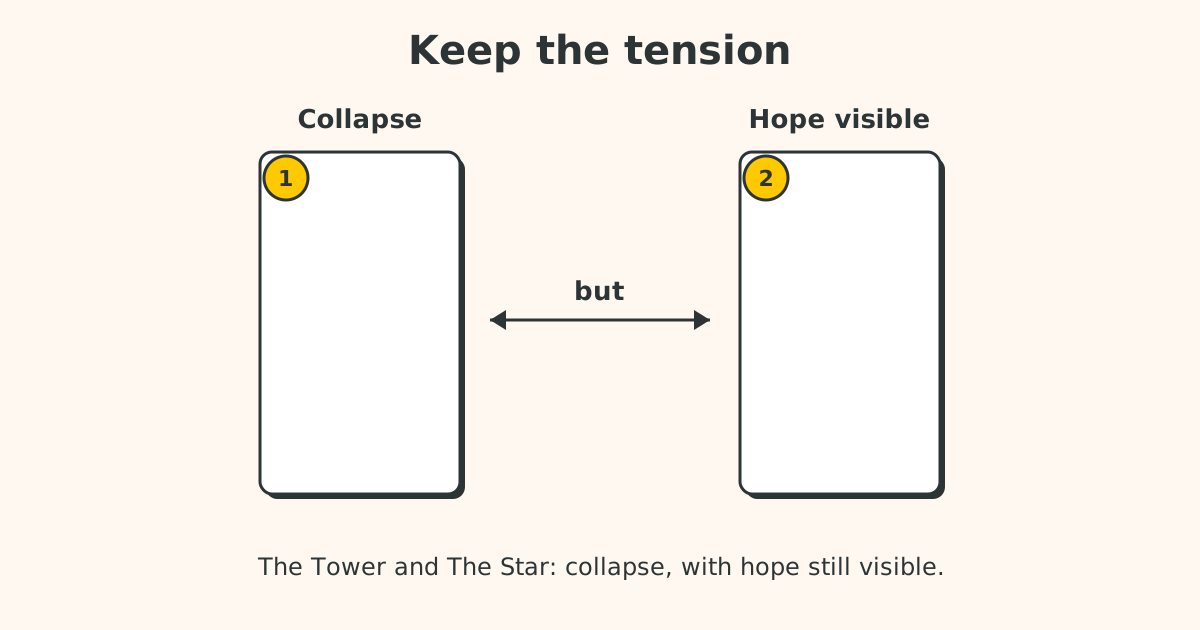
Contradictory pairings are often the heart of the answer. Do not resolve them away. The Tower + The Star means collapse with hope visible; Tower + Nine of Swords means collapse without comfort. Use conjunctions to hold the tension: Strength + Five of Swords reads as “inner resources exist, but using them this way may cost you”. A conflict between what you want and what is projected can be read as changeable through changed beliefs, not as a fixed opposition.
When two cards seem to disagree, try linking them with because, but, so, or despite. If a conjunction fits, you have a reading. If none fits, the contradiction itself may be the answer—do not force a false harmony.
Reversed Cards and Directionality
Most guidance on combinations assumes upright cards; directionality is sometimes treated as an optional extra layer rather than a core part of combining. If you read reversals, treat any reversed meaning as part of your named personal system: decide what a reversal means—blocked, internal, delayed, or something else—and apply it consistently before combining. Do not present that choice as a universal rule.
Directionality beyond reversal (for example, facing figures) is not a documented combination rule and should be used as personal reading style, not presented as universal.
Reversals are optional. If you do not use them, do not force them mid-reading. If you do use them, decide what a reversal means in your practice and stick with that meaning for every card before you begin combining.
Worked Examples: Three Rider-Waite-Smith Spreads
These examples use common Rider-Waite-Smith card meanings drawn from instructional tradition, not universal laws. Each example states the position first, then explains what each card contributes.
Two-Card Contrast: The Tower + The Star
Start with a two-card contrast: The Tower as the situation and The Star as what is emerging from it. The Tower contributes a collapse or rupture; The Star contributes visible hope or something on the other side. Read together, the pair says collapse is happening, but hope is visible after it. Place the Nine of Swords beside The Tower instead of The Star, and the same Tower reads as collapse without comfort. The second position changes whether the first card's disruption opens toward hope or closes toward distress.
Three-Card Past–Present–Future: Five of Cups + Eight of Cups + Three of Wands
In a past–present–future spread, Five of Cups in the past contributes a loss that has not been fully processed. Eight of Cups in the present contributes a deliberate, chosen departure from the situation that caused it. Three of Wands in the future moves the sequence forward. Read as one arc, the three positions narrate a recovery process rather than three separate mood keywords.
Same Card, Different Positions: Four of Pentacles in Past vs Future
The card’s traditional meaning—possessiveness, control, and blocked change—contributes the same base meaning in each slot. In the past, that energy is receding; in the future, it is approaching. The position alone changes the card’s role without changing its assigned meaning. This shows why position must be read before combination. See the Four of Pentacles meaning page for individual card details, but notice that its contribution to a combination depends on where it lands.
Building One Overall Narrative
After you identify pairs and patterns, combine them into one statement or story. Use conjunctions—because, but, so, despite—to link cards in sequence. If no conjunction fits, you have described the cards, not read them. One recommended practice: read a three-card spread three ways—left-to-right, outside-in, and center-out. Each method reveals a different narrative emphasis. Another practice: state the finished reading in one sentence without card names; if you cannot, you may still be describing the cards rather than the reading.
A simple way to test your conjunction choice is to replace it with another and see if the meaning changes. For example:
| Conjunction | Relationship it creates |
|---|---|
| because | cause and effect |
| but | contrast or friction |
| so | consequence or next step |
| despite | tension held together |
If you can swap conjunctions and the sentence still feels true, you may be describing the cards separately rather than reading them together.
Don’t Force It: Working with Ambiguity
Do not invent a connection that is not there. If a pair or spread remains unclear, say so. Ambiguity can be the accurate reading: the situation itself may be unresolved. One way to work through ambiguity is to return to the spread, name each position, and ask how the two cards modify each other in that specific pair. If you drew the cards from a physical deck, you can enter them into the Physical Tarot Card Interpreter and ask how they relate. Treat its answer as one more prompt for your own thinking, not a final verdict. Avoid treating repeated cards as proof of a real-world probability. Repetition is thematic weight, not fate or outcome.
If a pair remains ambiguous, hold the ambiguity rather than forcing a false connection.