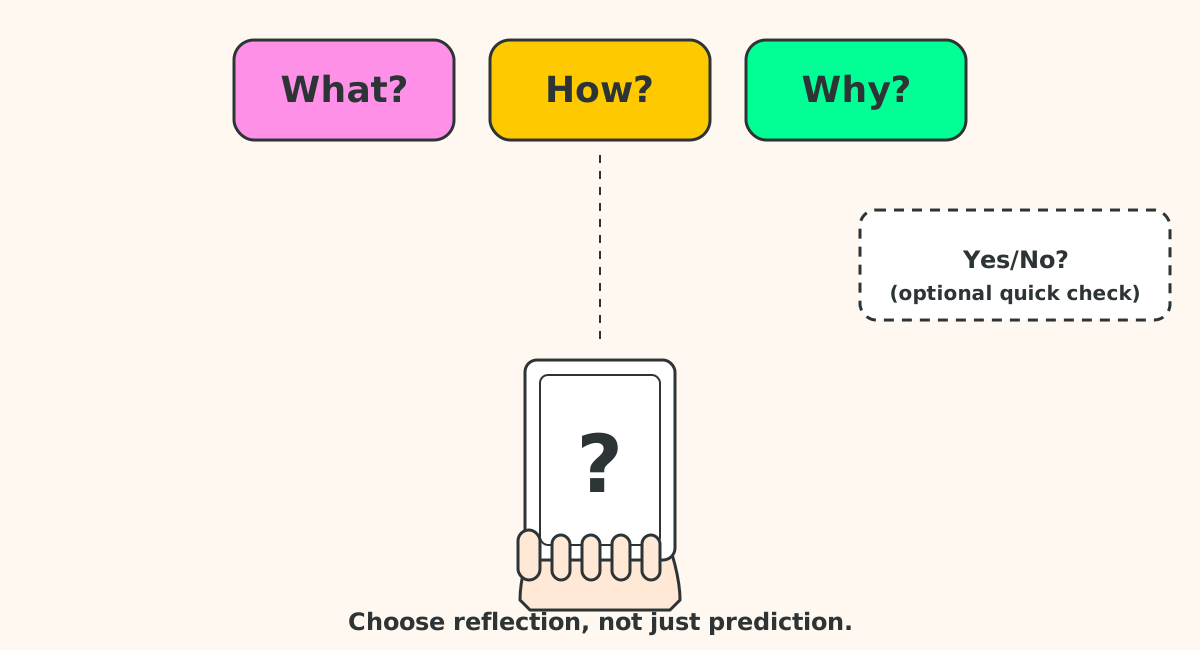
Open-Ended and Closed Questions: Start Here
A closed question asks for yes or no. "Will I find love soon?" is one example. It feels direct, but the downside is that yes-or-no questions often flatten a reading and can shut down exploration instead of opening it. When only two answers exist, there is less room to notice why something is happening or what you might do with it.
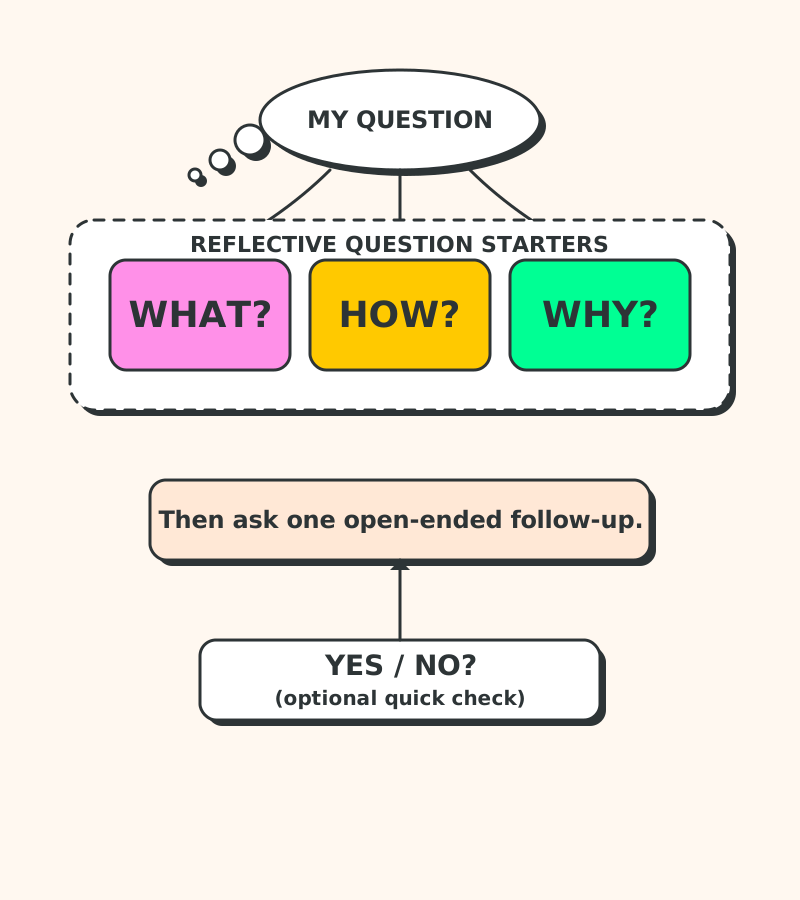
Open-ended questions begin with what, how, or why. They invite reflection, reveal patterns, and keep your own choices in view. Biddy Tarot recommends avoiding "Will," "When," or "Should" as starting words and using "What," "How," or "Why" instead. The result is usually more specific, more interesting material to work with.
That does not mean a yes-or-no question is wrong. It just means you can notice when another phrasing might give you more to chew on. For example, instead of "Will I get that new job?" try "What could help me get a new job?". The wish is the same; the question makes room for a next step.
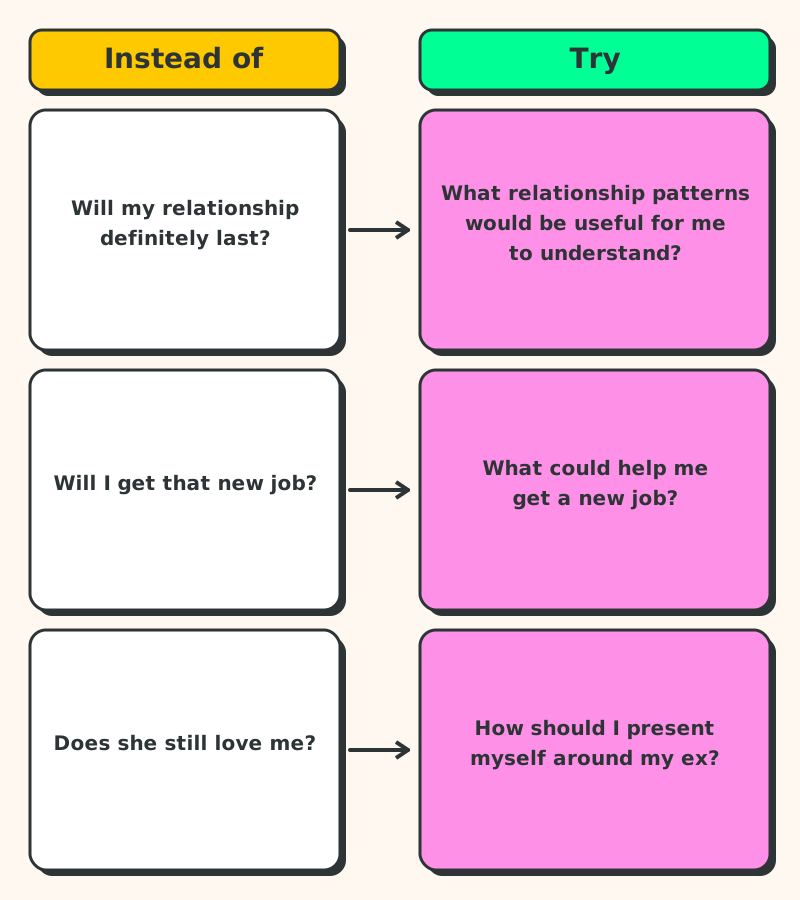
Quick Question Makeover: Instead of / Try
The table below pairs common predictive questions with one open-ended alternative each. The left-hand questions are not forbidden. The right-hand versions are tools for when you want a more spacious reading.
| Instead of | Try |
|---|---|
| "Will my relationship definitely last?" | "What is the state of our relationship right now?" |
| "Will I find love soon?" | "What should I keep in mind as I look for love?" |
| "Is my son lying to me?" | "What do I need to know as a parent right now?" |
| "Will I get that new job?" | "What could help me get a new job?" |
| "Should I take this opportunity?" | "How can I tell whether an opportunity is worth pursuing?" |
These are not corrections. They are reframes from practitioner suggestions about turning closed predictions toward the querent's own understanding.
Questions for Relationships and Connection
Relationship readings tend to work better when they focus on your patterns, your lessons, and your role in the connection, rather than trying to read another person's private thoughts. One reader describes pulling cards to read someone's mind as ethically questionable and likely to produce unclear answers. A forum participant says they avoid third-party questions altogether.
Try these:
- "What is the state of our relationship right now?"
- "What lessons am I learning through this relationship?"
- "What's the best way to approach finding the right relationship for me?"
You can also turn third-party questions toward your own conduct. Instead of "Does she still love me?" try "How should I present myself around my ex?". Instead of "Is my son lying to me?" try "What do I need to know as a parent right now?". When a relationship card such as Three of Cups appears, read its imagery in the context of your question instead of treating it as a simple verdict.
Some spreads include a position for a relationship's "most likely outcome". Even then, the same reader adds that free will matters: you can act on what you learn and change a pattern you do not want.
Questions for Career and Work
Career questions are often more useful when they explore blocks, values, strengths, support, burnout, and transition steps than when they demand a fixed job prediction. Career-focused tarot guidance includes:
- "What do I need to understand before making a major career change?"
- "Where am I getting in my own way professionally?"
- "What steps can I take to transition to a new career without sacrificing what I've already built?"
- "How can I overcome burnout and reignite passion?"
You can still ask a yes-or-no career question like "Is this job offer right for me?" Tarot.com's career page includes that closed example, while Biddy Tarot leans toward open questions. One practical move is to pair the closed question with a reflective follow-up from the same career lists: "How can I tell whether an opportunity is worth pursuing?". A card like The Fool works best in a career reading when read in the context of the question, not as a fixed verdict.
Spreads help map the terrain. A ten-card career spread or a Career Celtic Cross may include positions for challenges, allies, advice, self-undermining tendencies, and circumstances still forming. In Tarot.com's Career Celtic Cross, the Advice position is traditionally described as "a course of action which will harmonize what you want with what is currently possible". That is a helpful frame: guidance, not a guarantee.
Questions for Personal Growth
Personal growth questions often use contrasting pairs to reveal choices. The Cartomancer's method asks two questions built on an oppositional pair, then reads a three-card string for each side. Examples:
- "What is my super power? What is my greatest weakness?"
- "What must I put down? What must I hold on to?"
- "How do I give? How do I receive?"
You can also ask about challenges and preparation. Forum readers offered examples like "What important lesson can I learn from this recent challenge?" and "What is the best way to prepare for an upcoming event?".
The cards work as prompts. Biddy Tarot gives an example with The Hermit: under a self-focused question such as "What can I do to create the love life I truly desire?", the same card can be read as a call to spend time on your own and reflect on the relationship you want before seeking external change. That is an invitation to look at inner work, not a permanent verdict.
Questions for Difficult Decisions
Difficult decisions respond well to questions that separate the choice from the pressure to be right. The Cartomancer suggests paired questions like "How do I choose? Why must I make a decision at all?". Another pair is "What must I put down? What must I hold on to?". These move the reading away from "tell me the answer" toward "show me the shape of the decision."
Try not to make "Should I..." the whole question. That phrasing can hand the decision to the cards. John Beckett is blunt: never surrender your autonomy to a deck of cards. Instead, ask what you need to know to make the decision yourself. A reading can show trade-offs and consequences, but the choice remains yours.
Why Repeated Prediction Questions May Be Less Helpful
Asking the same prediction over and over can become a way of fishing for the answer you want rather than the one you need, as one Tarot Forum participant puts it. The deck is not a magic 8-ball; there is no fixed "yes" card and no fixed "no" card.
If you feel stuck, wait until the situation changes, or reword the question to focus on a specific element you still want to understand. One practitioner suggests waiting about a month before repeating a reading on the same subject unless something shifts. Another forum participant says they wait about six months unless the situation changes significantly. Clarifying questions can be useful when they ask about a card or part of the reading, not when they repeat the original demand for a forecast. For advice-oriented questions, some readers find value in getting multiple perspectives, "kind of like establishing a think tank," though they also recommend being honest with readers about that.
Interpreting a Reading Without Treating It as an Instruction
A tarot reading offers perspective, not a command. You still do the practical work and make your own choices. John Beckett compares a reading to consulting a friend for a different, more objective take; you want perspective, not someone solving the problem for you.
Read the card images in the context of your question rather than reciting one fixed meaning. The Hermit shows how this works. If you ask "Will I ever find love?" and pull the Hermit, one disempowering reading treats it as a flat "no." The same card under "What can I do to create the love life I truly desire?" can be read as a prompt to spend time on your own, reflecting on the relationship you want, before seeking external change. The image did not change; the question did.
Notice what is absent as well as what is present. If you feared the Ten of Wands or the Tower and they do not appear, that absence can be meaningful. Even an "outcome" card is not set in stone: free will and changed actions can shift the path.
Practical Examples: Improving Your Question in Action
Example 1: Love. "Will I ever find love?" can become "What can I do to create the love life I truly desire?". You pull The Hermit. Biddy Tarot reads the same card as a call to spend time on your own before seeking a partner, not as a permanent "no".
Example 2: Work. "Will I get that new job?" becomes "What could help me get a new job?". Instead of waiting for a yes or no, you get a direction to act on. You might draw the Page of Pentacles and ask what its imagery suggests about your practical next step in the job search.
Example 3: A difficult decision. Split the question into two: "What must I put down?" and "What must I hold on to?". Draw one card for each, then read each card's function in relation to the neighboring card, as the Cartomancer advises. Each half keeps the focus on what you can do next.
In each case, the reworded question keeps your agency front and center.
A Small Checklist Before You Pull Cards
Before shuffling, pause and ask yourself: Am I asking the right question? Is it open-ended? Does it get to the heart of the matter? Are there follow-up questions I could ask?.
If you still want a quick yes-or-no check, Yes or No Tarot is one format. You can also bring an open-ended version to Ask Tarot AI and notice what patterns show up.