Tarot as a Reflective Practice, Not Prediction
What 'reflective tarot' means
Reflective tarot treats a card as a prompt for noticing what's already present: your mind, habits, and available choices. In that use, the deck works as a mirror of your current state, repeated patterns, and options, not as a fortune-telling machine. A mirror doesn't forecast; it shows what you're carrying right now.
Nothing in a card reading is clinical evidence. Tarot can support reflection, journaling, or creative exploration. It cannot verify facts, diagnose conditions, determine another person’s private thoughts, guarantee an outcome, or replace professional advice. Cards are symbolic prompts, not evidence.
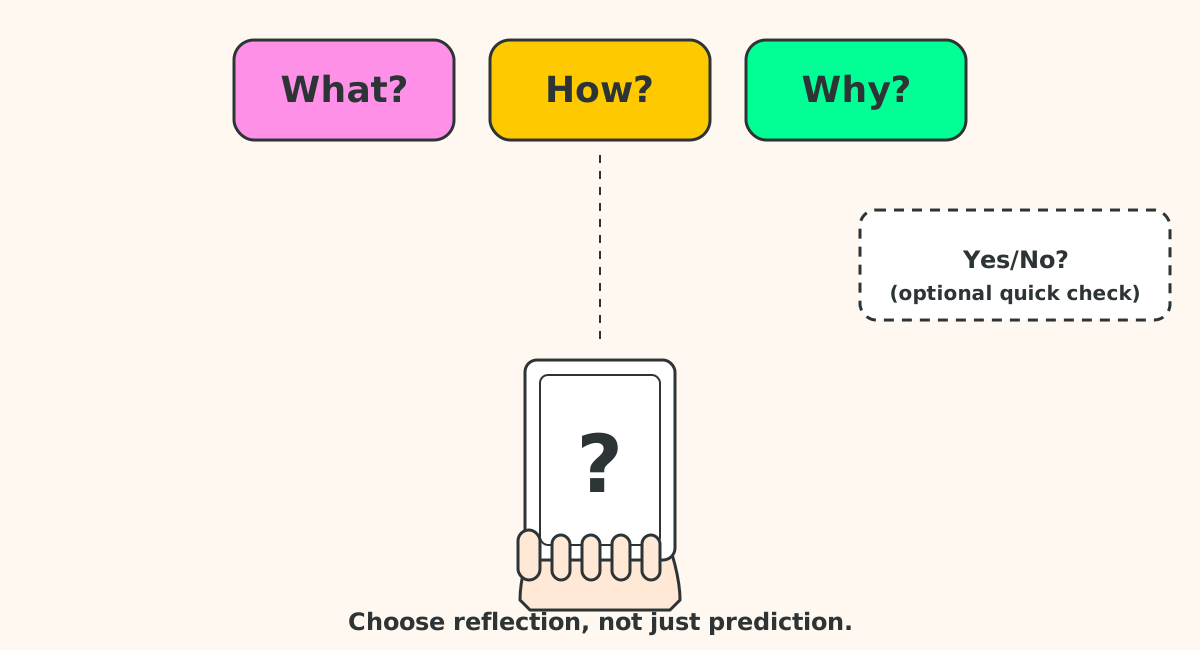
The Major Arcana can be framed as twenty-two states of being rather than predictions about what will happen next. That's one interpretive lens, not a universal rule. When you draw a card, the useful question is usually “What does this image invite me to consider?” rather than “What will happen?”
Why reflection works for personal growth
Personal growth comes from noticing what you project onto a card and what that reveals about your current mindset. A card of tension may remind you that you've been avoiding a conversation. A card of rest may point to a boundary you keep postponing. The card itself doesn't create the insight; your response to the image names it.
Reflective readings work best when they're open and specific. Ask, “Where does this energy show up in my life?” or “What part of me recognizes this scene?” You're not searching for a hidden message. You're using the image as a neutral outside perspective—an alternative angle, not an omniscient authority.
Using Tarot Symbols to Shift Your Perspective
Building personal card associations
A useful method is building a personal vocabulary for the cards from your own memories, emotions, and cultural references. One practitioner-guided journaling approach suggests placing a card on a page and creating a mind map: branch into feelings, memories, films, books, songs, sensory details, or people the card calls to mind. Not every branch will lead somewhere useful. Some go blank, and that's fine.
After mapping, distill two or three keywords. A card that reminds you of a difficult elevator ride and a song about leaving might become “pressure,” “exit,” and “uncertainty.” These are your correspondences, not textbook definitions. The point is resonance, not neatness.
Reading a card from multiple angles
Even familiar cards carry more than one angle. Two of Swords is traditionally read as indecision or a binary choice. Instead of stopping at “I feel stuck,” ask: “Which choice have I been avoiding? What would help me look at this directly?” The same image can help you name the two options.
Eight of Swords is traditionally seen as self-imposed restriction, self-doubt, or disempowerment. In a reflective draw, you might ask: “Where have I assumed I can't move, when a small step is actually possible?” That question can turn anxiety into a clearer observation.
Treat the card as a thinking partner, not a command. If an image pushes you toward a forced conclusion, sit with it longer or set it aside. Reflection isn't about forcing every card to match your day.
Journaling with Tarot: A Practical Template
Daily one-card draw and evening review
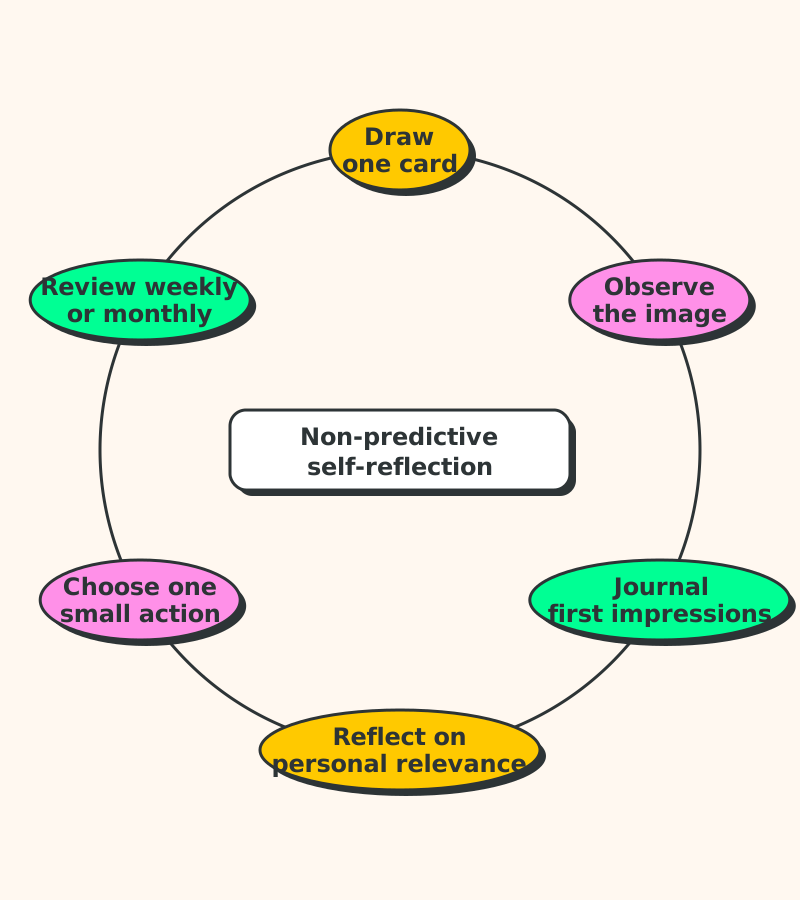
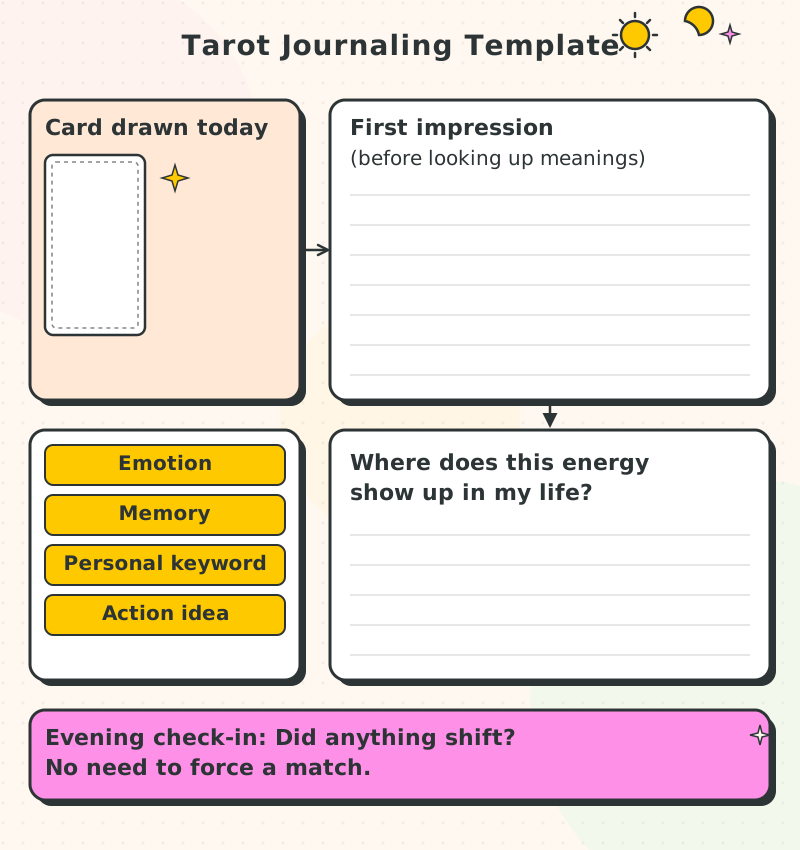
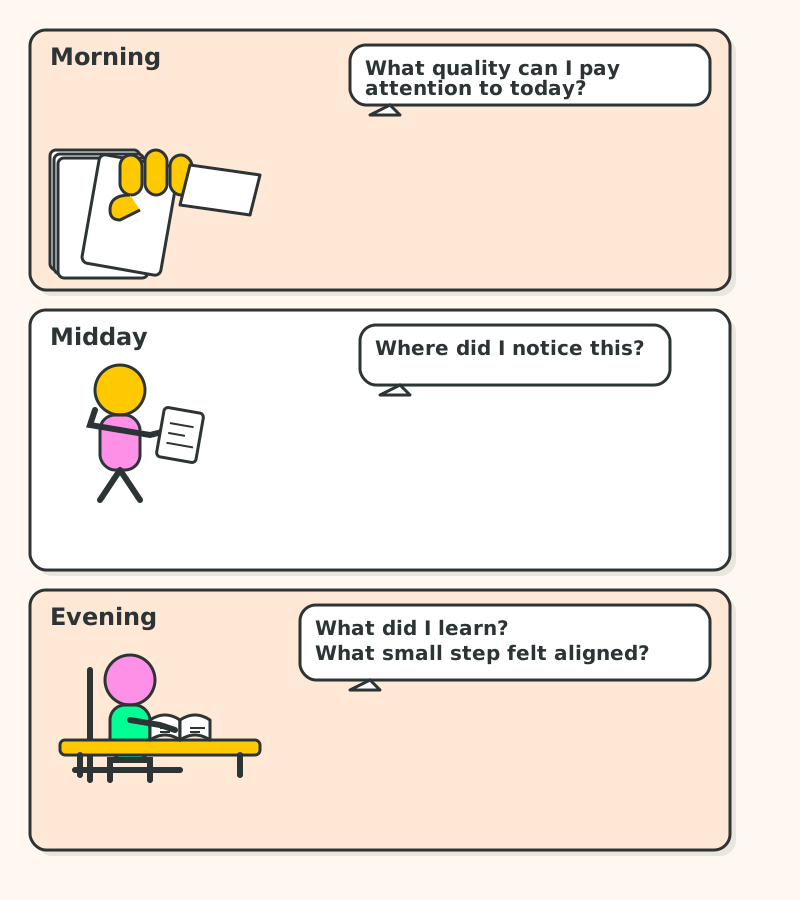
One low-pressure pattern is a morning card and an evening note. Draw a single card, write a few lines about your first impression before looking up any standardized meaning, then revisit the card at the end of the day. You don't need to force a match between card and event. The goal is to notice whether anything shifted in how you understand the image.
Some readers find a daily draw helpful; others prefer weekly or monthly. There's no required frequency. If daily practice starts feeling like an obligation, scale back. The practice supports reflection, not chore-keeping.
Structured prompts for deeper reflection
Try a small set of prompts instead of free-writing every time:
- What emotion does this card evoke right now?
- Where in my life does this energy show up?
- What small action could I take that aligns with the card’s invitation?
- If this card were a question to myself, what would it ask?
Track only one or two elements at first—such as a recurring card or a dominant suit—rather than logging every detail. Accept blank branches or no clear connection as useful information. It may mean the card isn't personally resonant today, and that's still data.
Review your journal regularly. Ask which cards recur, which themes persist, and what has changed since a card first appeared. That turns scattered entries into a record of your attention.
Noticing Recurring Themes and Patterns
Tracking repeated cards and suits
When the same card appears across several readings, some practitioners treat it as an invitation to explore an ongoing lesson or familiar pattern, not as a warning. You might ask: “What am I avoiding? What pattern is asking for attention? What choice is available?”
Suit themes can help organize reflections, but they're traditional or personal correspondences, not fixed rules. One tarot blog describes common associations:
| Suit | Common reflective theme |
|---|---|
| Cups | Emotions and relationships |
| Wands | Growth, creativity, ambition |
| Swords | Mental challenges, communication |
| Pentacles | Stability, resources, practical concerns |
This table is one practitioner’s framing. Other decks and traditions may use similar correspondences, but no evidence makes them objective. Use them as a starting point, not a verdict.
Optional tracking prompts like moon phases or zodiac seasons are just that—optional. A new moon reading might focus on intentions, a full moon on clarity, but these are personal or traditional prompts, not determinants of card meaning.
Interpreting recurrence as invitation, not omen
Recurring cards can be meaningful without being supernatural signs. If the same card keeps showing up, treat it as a cue to look at one theme more closely. You might notice you've been pulling Two of Swords whenever you postpone a hard conversation. The card isn't predicting an unavoidable choice; it's reflecting a pattern you already know.
Recurrence isn't evidence of fate or external messaging. It's a reflective cue, and you decide whether it's useful.
Reflecting on Relationships and Big Decisions
Using cards to explore relational patterns
For relationships, a reflective draw can open questions that are hard to ask directly: “What am I bringing to this dynamic? What might I be ignoring? What boundary or conversation feels overdue?” These questions keep the focus on your own patterns, not decoding another person’s behavior.
Tarot cannot tell you what another person thinks, guarantee an outcome, or replace your own judgment. It offers a structured pause to examine your assumptions. If a reading starts to feel like surveillance of someone else’s private mind, step back. The useful material is usually your own discomfort, hope, or hesitation.
Decision-making with tarot as a thinking partner
For a decision, the point isn't to score options but to surface what each option means to you. A short spread can help you see your own patterns. You might use a card as a prompt and still list practical pros and cons from your own experience and real circumstances.
The Two of Wands, traditionally a figure holding a globe and looking out over the sea, is often read as a question about whether to leave comfort to pursue what you want. In a reflective decision reading, that card can prompt: “What risk feels aligned with my values, and what am I willing to release?” It's a reflection prompt, not a sign.
Building a Sustainable Tarot Reflection Routine
Starting small and flexible
If daily practice feels like too much, use a weekly or monthly draw. Start with a single card and one sentence. Try a card of the day as a reflective prompt: “What quality can I pay attention to today?” rather than “What will happen?”. That keeps the practice open and non-predictive.
When you feel stuck, you can use a guided reflective reading. If you want to try one, try a guided reflective reading with Ask Tarot AI, which can help you explore a card as a prompt rather than a forecast. If you prefer a single card, draw a card for today is a simple place to start.
Pair tarot with your own judgment. Some readers consult cards only when clarity is otherwise difficult, and they still make the final decision themselves. That balance is healthy.
Weekly and monthly check-ins
A weekly review can reveal patterns that are hard to see while you're still holding the deck. One practical method is to keep original journal entries unchanged and write a separate review page. Go through each entry and ask what underlying concern it was really about. You may find that three differently worded questions all reduce to the same worry.
Then check whether you assigned the same meaning to a card regardless of position or question. If a familiar label arrives before you've read the context, you may be sorting, not interpreting. Finally, mark the actions you actually took. If a reading produced vague advice, rewrite it as a concrete, observable step rather than pulling more cards.
If you miss days, simply resume. Consistency matters less than honest engagement when you do sit with a card.
Knowing What Tarot Can and Cannot Do
Distinguishing reflection from prediction
Tarot cannot verify facts, diagnose conditions, determine another person’s private thoughts, or guarantee outcomes. It isn't a test for medical, legal, or financial questions. It isn't a lie detector or a timetable.
Avoid predictive claims about death, pregnancy, disease, criminal guilt, court outcomes, investment returns, or infidelity. Those topics require factual or professional support, not card interpretation. A careful reader offers a reflective interpretation only after stating that boundary. You might say: “I can help you explore what this symbol might mean for your feelings, but I cannot tell you what will happen or what someone else thinks.”
Uncertainty is part of the practice. A card may reveal more than one possible angle, and not every draw will feel meaningful. That isn't a failure of reading; it's the nature of symbolic work.
High-stakes questions and safety
If a reading touches on crisis or safety concerns, the first step is real-world support, not more cards. In situations of immediate danger, self-harm, abuse, or a medical emergency, crisis support comes before any card. Tarot isn't equipped to manage those needs.
Keep symbolic interpretation distinct from factual claims. You can explore a card’s emotional resonance without asserting that it proves something about the future or another person. That boundary protects the practice and the person using it.
Healthy Boundaries and Avoiding Overdependence
Signs of overreliance
Repeatedly checking cards or withdrawing into tarot can become a substitute for decision-making. Some practitioners describe a felt need to read—or a tendency to pull cards instead of acting—as a signal to pause and reassess. Not every urge to read is a problem, but a pattern of asking the same question without changing anything deserves attention.
If journaling or review increases anxiety, shame, or compulsive checking, step back and seek appropriate support. One forum commenter suggests tarot addiction is exceptionally unlikely, but that's an anecdotal opinion. A journaling guide warns more cautiously that repeated review can feed distress. Treat any escalation in distress as a reason to stop, not a reason to read more.
Stepping back constructively
Don't count broad outcomes as “correct” or force matches between daily cards and events. That can reinforce a false sense of control. Instead, use tarot as one tool among many—alongside self-reflection, conversation, and professional advice when needed.
A healthy practice invites curiosity and agency. If a reading feels constraining or fear-inducing, set the cards aside and return when grounded. The deck isn't in charge. You are.
Healthy Reflection in Action: Three Examples
Worked example 1: A card for processing a conflict
After a tense conversation, you draw Strength. Instead of asking “Who will win?”, you journal: “Where am I using force when compassion or self-control would serve better? What would confident, non-reactive strength look like here?” You notice a defensive habit and plan one open-ended question to invite dialogue. The card becomes a prompt for changing your own behavior, not a prediction about the relationship.
Worked example 2: A decision prompt
Facing a job choice, you draw Two of Wands. The figure looking out from a balcony with a globe raises the question of whether to leave comfort to pursue what you want. You journal: “Which option is about familiar comfort, and which is about a goal I want enough to release something for?” Then you list concrete pros and cons from your own knowledge. The card surfaces a tension you already feel; it doesn't decide which job is better.
Worked example 3: Tracking a recurring theme
Two of Swords appears in three separate weekly draws. Rather than expecting a secret message, you review your journal and notice you've repeatedly avoided naming a binary choice. The card is traditionally read as indecision and a decision that must be made. You sit down, name the two options, and schedule one concrete conversation. The recurring card helped you name a pattern you already carried.
In each example, the card serves as a prompt for self-inquiry, the interpretation stays open, and the next step is a small, self-chosen action.